Windenergie 3 - Fatigue 1
13 May 2026, Po Wen Cheng
Questions at the beginning
- Which forces contribute to the lead-lag (edgewise) motion of the blade?
- coriolis forces
- inertial forces
- stiffness forces
- drag (not a lot)
- The first natural frequency of the larger offshore wind turbine (and rotor diameter)
- will decrease
- Where do you see an excitation problem for the system, mark it on the Campbell diagramm
- Where the natural frequencies cross the excitation frequencies
- How many degrees of freedom a OpenFast model contains approximately?
- 25
- If the maximum stress is 2 times the minimum stress and both of them are tension stresses (pulling stresses), the stress ratio will be
- 2
- stress ratio is defined as $R = \frac{\sigma_{\text{lower}}}{\sigma_{\text{upper}}}$
- For materials such as fibre reinforced plastic
- higher fatigue life can be achieved with tensions stresses
- during a storn the wind turbine suffers large amplitude loads, which materials will suffer more damage relative to the normal loading conditions
- blade (m=10)
- At which site the wind turbine blades will have a longer lifetime
- blade damage equivalent load DEL = 150 (Less means less damage)
- Given the same number of cycles, same site, same materials, ... Which load will produce the same damage
Basics of Fatigue
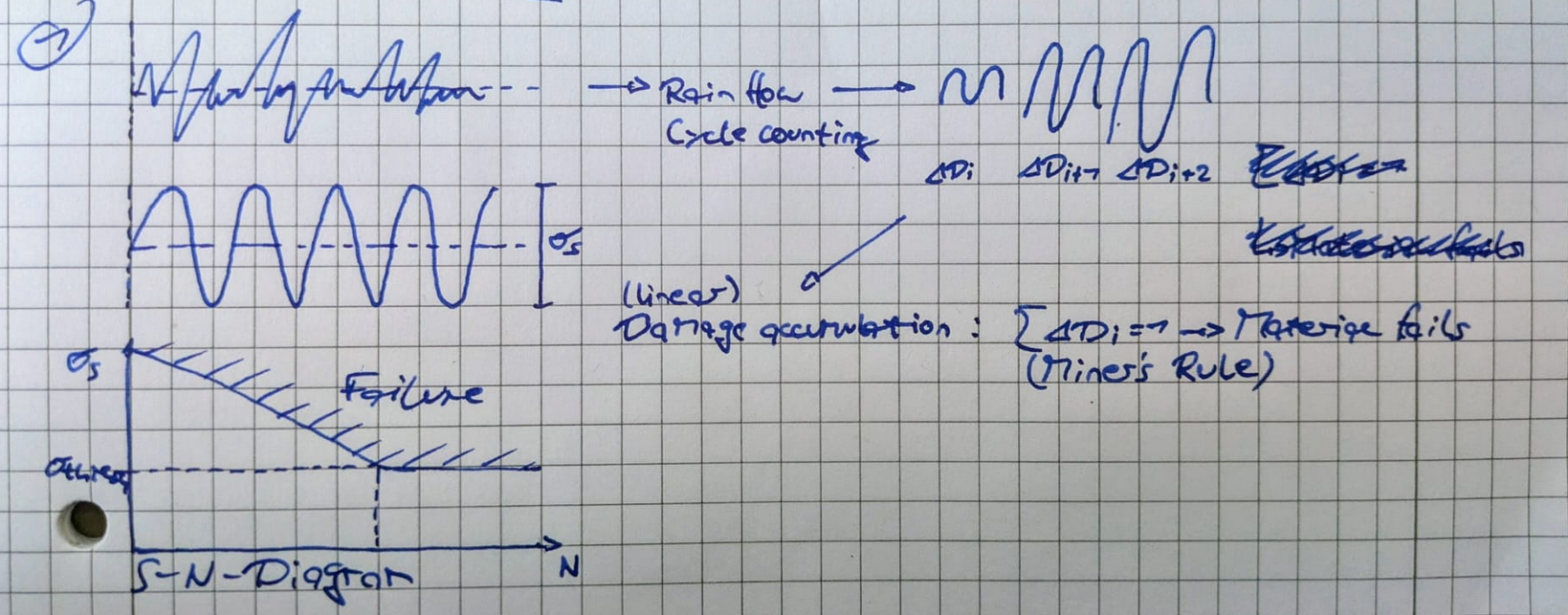
If you are below a certain stress intensity, there is no crack growth. Above, the crack will grow linearly
(See Paris-Erdogan Crack Growth Law on Slide 9)
$$ \int_{a_i}^{a_f}\frac{da}{\left( F(a) \cdot \sqrt{a} \right)^m} = C \cdot \Delta \sigma ^m \cdot \pi^{\frac{m}{2}} \cdot N $$
$N$ is the number of cycles for the crack to grow from an initial size $a_i$ to a final size $a_f$
Stress Ratio R
- S-N curve depends on the stress ratio (mean stress level)
- The dependency of the mean stress varies from material to material, steel material is less sensitive than fibre reinforced composite material or concrete material
- Compression stress more favourable than tension stress
Experimental S-N Curve
- S-N curves are determined from experimental tests from samples
- Test is carried out for a statistical significant number to determine the probability destribution and characterisitc values (median, P95, etc.)
- Test is carried out for different mean stresses
- Fatigue characterization of materials is very time consuming and expensive
Linear Damage Accumulation Hypothesis
- Partial damage from different stress ranges can be added linearly
- Sequence of the load cycles has no influence on the fatigue damage (in reality the micromechanical changes of the material depends on the loading sequence)
$$ D = \sum _i \frac{n_i(\Delta \sigma _i)}{N_i(\Delta \sigma _i)} $$
- $n_i$: actual number of stress cycles
- $N_i$: number of allowable stress cycles