Wind Turbine Aerodynamics - 7 - Fundamentals of Acoustics
20 August 2026, Cordula Hornung
Why is WTN noise important?
- Turbines are built in areas with lower wind speed - larger rotors are needed
- Maximum rpm and tip speed ratio are capped - turbines are becoming larger but not louder
- New turbines are closer to urban areas
- High capacity factor is needed
- New regulations need to be met
Basics of sound
Speed in solid materials:
$$ c_0 = \sqrt{\frac{G}{\rho}} $$
Speed in general fluids
$$ c_0 = \sqrt{\frac{K}{\rho}} $$
Speed in air
$$ c_0 = \sqrt{\kappa R T} $$
$G$: shear modulus
$K$: bulk modulus of elasticity
$\kappa$: heat capacity ratio
The decible scale
Human hearing ranges over many orders of magnitude: $2\cdot10^{-5} \frac{N}{m^2}$ to $2\cdot10^2 \frac{N}{m^2}$
Usage of a logarithmic scale:
$0 \text{dB}$ to $120 \text{dB}$
Sound pressure level: property at an observer location
$$ L_p = 10 log(\frac{p^2_{rms}}{p_0^2}) = 20 log (\frac{p_{rms}}{p_0}) $$
Sound power level: property of the source of the sound
$$ L_W = 10 log(\frac{p}{p_{ref}}) $$
- Sound intensity is energy transmitted per unit time and unit area (or: power per unit area)
- Acoustic impedance is resistance against sound propagation
How can spectral content be described?
- Sound is made up of superimposed time continous pressure fluctuations of different frequencies
- often, it is described with spectra
- spectra are obtained from the time continous signal by applying a fourier transform
- doubling the frequency changes the pitch by one octave (approximately)
- doubeling the distance decreases the sound pressure level by 6 dB
Directivity
| Monopole | Dipole | Quadrupole |
|---|---|---|
| isotropic sound waves are propagating from the source location - mass source | more specific propagation direction - momentum source | composed of two dipoles - volume sources |
| moving volume | -- | free turbulence |
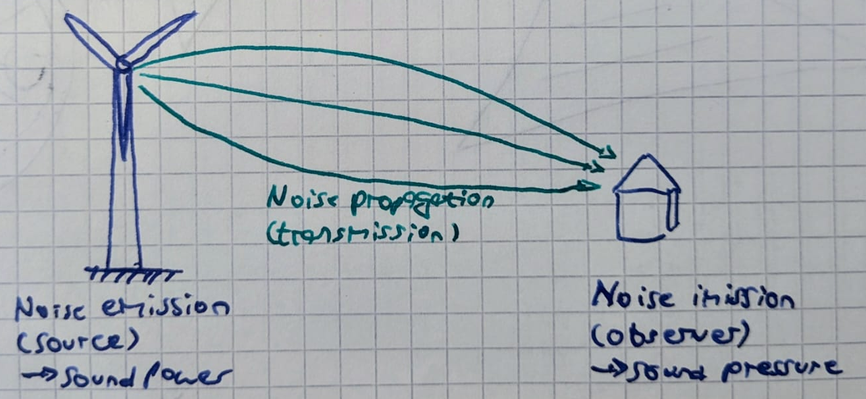
- noise can be evaluated using different parameters:
- sound pressure level spectrum
- overall sound pressure level: sum of the SPL over all frequencies
- A-weighted sound pressure level
- equivalent sound pressure level: average sound pressure level over a certain time frame
Far Field vs. Near Field
Geometric: contribution of different parts of the source at the observer are independent from the location of the observer ($r >> R$)
Phase difference: pressure and particle velocity have the same phase in the far field, whereas they have a phase difference of $90\degree$ in the vicinity of the source
Compact Source: dimension of the source is smaller than the corresponding wave length
Non-Compact Source: dimension of the source is equal or greater than the corresponding wave length